

 Germany
 Switzerland
 Spain
 United Kingdom
Back to overview
22 November 2023
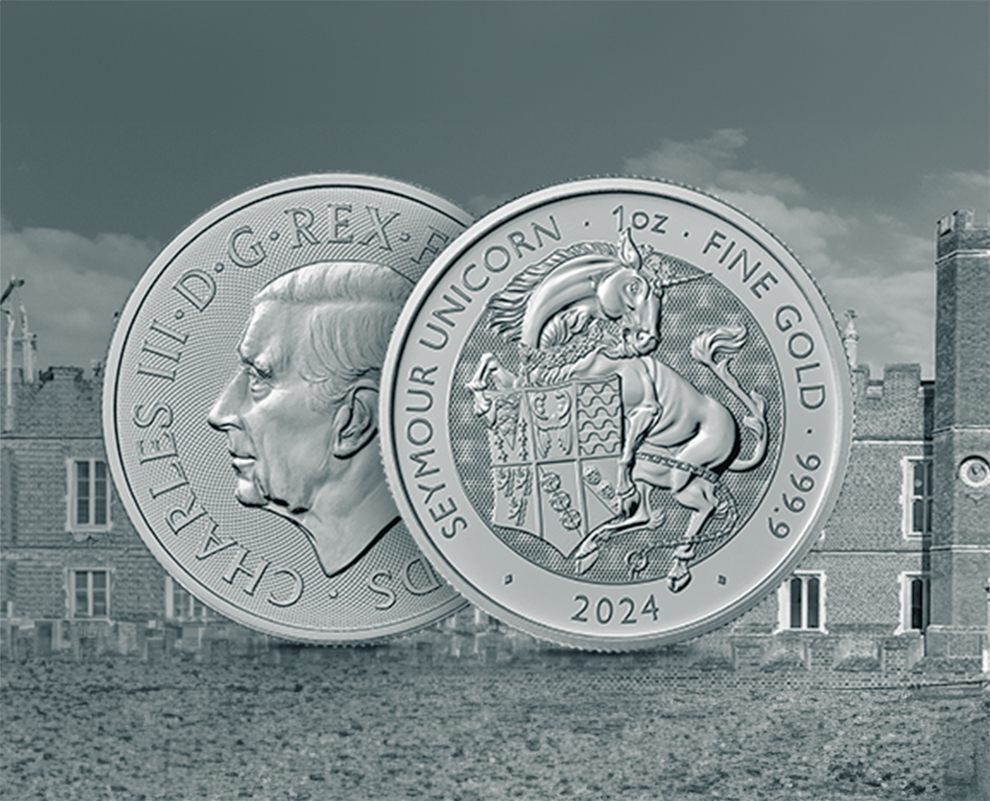
Seymour Unicorn – the new coin from the “Royal Tudor Beasts” series
The “Seymour Unicorn” – a new motif from the “Royal Tudor Beasts” series
After “The Queen’s Beasts” series, issued from 2016 to 2021, proved very popular with collectors and investors, the British Royal Mint is issuing the “Royal Tudor Beasts” coin series as its direct successor (since the end of 2021, but dated 2022). The “Seymour Unicorn” was officially released this month and is the fourth of a total of ten motifs.
The history of the Royal Tudor Beasts
The coin motifs of the “Royal Tudor Beasts” are based on the stone King’s Beasts on the “Moat Bridge”, the gate bridge of Hampton Court Palace (about an hour’s drive south-west of London). The English King Henry VIII had them made on the occasion of his marriage to his third wife, Jane Seymour, in 1536. The ten “beasts” are also an expression of the power of the House of Tudor, which was founded by Henry’s father, King Henry VII of England. It is a Welsh noble family that provided the monarchs of the Kingdom of England from the end of the “Wars of the Roses” (1455 to 1487) until 1603.It emerged from the Houses of Lancaster and York. After the male descendants of both houses had died during the civil war, which lasted more than thirty years, and the House of Lancaster had initially lost to the House of York, Henry VII married Elizabeth of York, the daughter of Edward IV, in 1486, thereby legitimising his rule over England after he had seized the crown a year earlier. His son Henry VIII continued to legitimise the Tudor dynasty and his rule and, among other things, commissioned the enormous rebuilding of his favourite residence, Hampton Court Palace. In just ten years, he invested the enormous sum of 62,000 pounds there, which would be more than 20 million euros today. This also included the ten Tudor Beasts, which hold the coats of arms of the dynasty and its ancestors and thus serve as a sign of legitimate rule.
The House of Tudor also gave itself its own coat of arms, the so-called “Tudor Rose”. While the symbol of the House of York was the white rose, the coat of arms of the House of Lancaster showed the red rose. In the Tudor Rose, both are united to form a red rose with a white heart. It can still be seen today in the coats of arms of the United Kingdom and of Canada. Incidentally, the last monarch of the House of Tudor was Elizabeth I, who ruled England from 1558 to 1603 and died childless. She was succeeded by James I of the House of Stuart, as he was a great-grandson of Margaret Tudor, the sister of King Henry VIII. Elizabeth I’s reign of 45 years was an enormous achievement, especially for that time. It was only surpassed by Elizabeth II, who ruled the United Kingdom for no less than seventy years (1952 to 2022).