 Germany
 Switzerland
 Spain
 United Kingdom
The new coin series “Masterpieces of German Literature”
The new annual 100-euro gold coin series “Masterpieces of German Literature”, which will consist of eight coins, focuses on literary works of exceptional importance to German culture. It is launched with “Faust” by Johann Wolfgang von Goethe, one of the best-known works in the history of world literature.
About Goethe’s Faust
At the centre of Goethe’s major dramatic work, for which he adapted a story from the early modern period, is the figure of the magician and devil’s ally Dr Faust. His quest to understand “whatever binds the world’s innermost core together”, the pact with the devil Mephistopheles, the tragic story of Margarete, the protagonist’s world of feelings, thoughts and experiences, and the overwhelming wealth of linguistic power and references to literary traditions and the world stage have inspired countless artists to create visual and musical adaptations.Work on “Faust” stretched, with long interruptions, over a period of 60 years and reflects Goethe’s changing view of emerging modernity. The Urfaust appeared in the early 1770s, followed by “Faust. Ein Fragment” in 1790. “Der Tragödie erster Teil” followed in 1808. Goethe worked on the second part, which at his request was only to be published after his death, mainly in the last seven years of his life.
Just as Goethe’s view of modernity changed, “Faust” has also had an eventful history of reception. The title character is regarded as the embodiment of modern man. At the end of the 19th century, he was the symbol of energetic striving and the glorification of scientific and technical progress; in the GDR, he was seen as a champion of the workers’ and peasants’ state. Today, the catastrophic consequences of Faust’s actions tend to be the focus of attention, interpreted as an astute diagnosis of the questionable nature of our modernity.
For Frankfurt-based Degussa Goldhandel, it is a particular pleasure that Frankfurt-born Goethe is once again being honoured with a gold coin. This continues a long tradition: as early as Goethe’s 100th birthday in 1849, a coin was minted in his honour from silver from the “Deutsche Gold- und Silber-Scheideanstalt (vormals Roessler)”. A commemorative coin was also issued on the 100th anniversary of his death in 1932. While the first coin was minted in Frankfurt itself, the 1932 coin was already minted at the five mints where the 100-euro gold coin is still produced today.
The coin motif
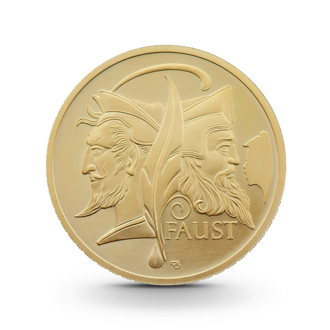
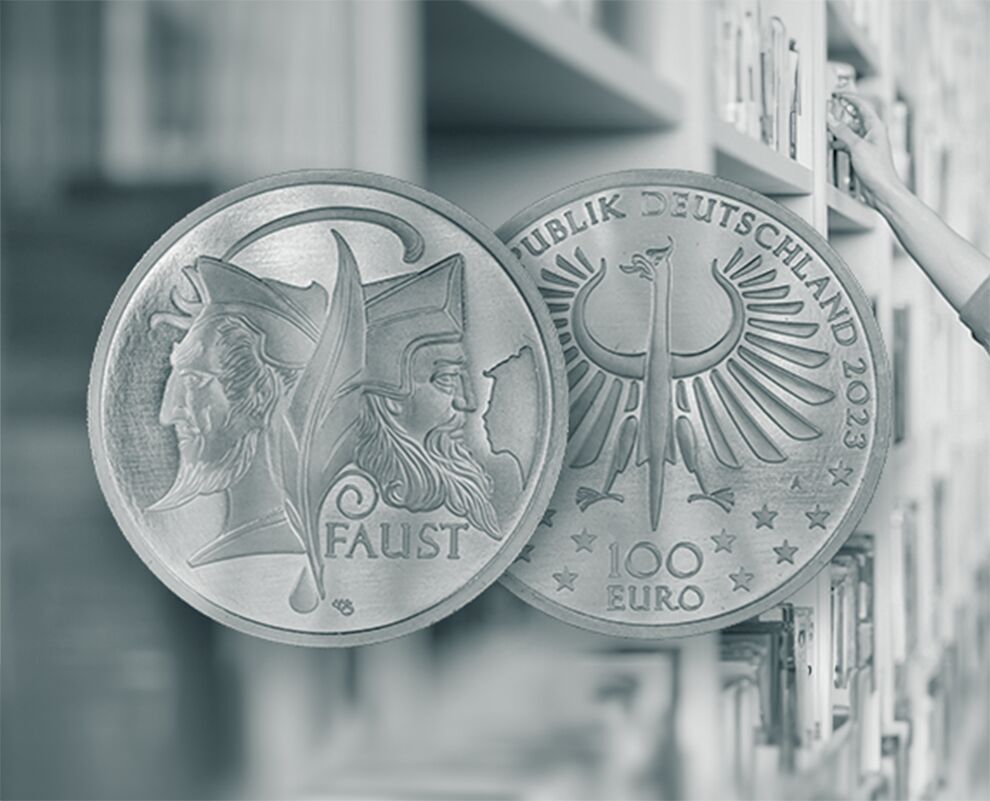
The motif, designed by the artist Michael Otto from Rodenbach, focuses on the heads of the two main characters at the heart of the drama: Faust and Mephisto. The Janus-like arrangement clearly shows their close, essential connection. The central motif of the quill combines the theme of literary writing with the pact with the devil that is characteristic of the drama, while Gretchen looks into the picture from the right. Finely sculpted, the motif is convincing both close up and from a distance and fills the coin surface excellently. With its dignified eagle, the value side complements the obverse perfectly.The inscription on the obverse is deliberately kept simple with “FAUST”. The inscription on the reverse reads “100 EURO BUNDESREPUBLIK DEUTSCHLAND 2023”.
Technical data
The coin is made of fine gold (999.9/1000), weighs 1/2 ounce (15.55 grams), has a diameter of 28 mm and a reeded edge. It is struck at all five German mints with a total mintage of up to 160,000 pieces. The issue quality is “brilliant uncirculated”. The VAT rate is 0% and the coin is supplied in a capsule with case and certificate.The new coin series “Masterpieces of German Literature” thus follows on seamlessly from the coin series “Einigkeit, Recht und Freiheit” (Unity, Justice and Freedom), which was issued from 2020 to 2023. All coins are available from Degussa and can be found in our online shop. The Federal Republic of Germany has also remained true to tradition in the issue of its coins: in the year the euro was introduced (2002), the full 200-euro ounce was issued as a one-off, at the same time the series of 100-euro half ounces began, and in 2017 the 50-euro quarter ounces followed. Only the 20-euro gold coins weighing 1/8 ounce (3.89 grams) stand out from the pattern.